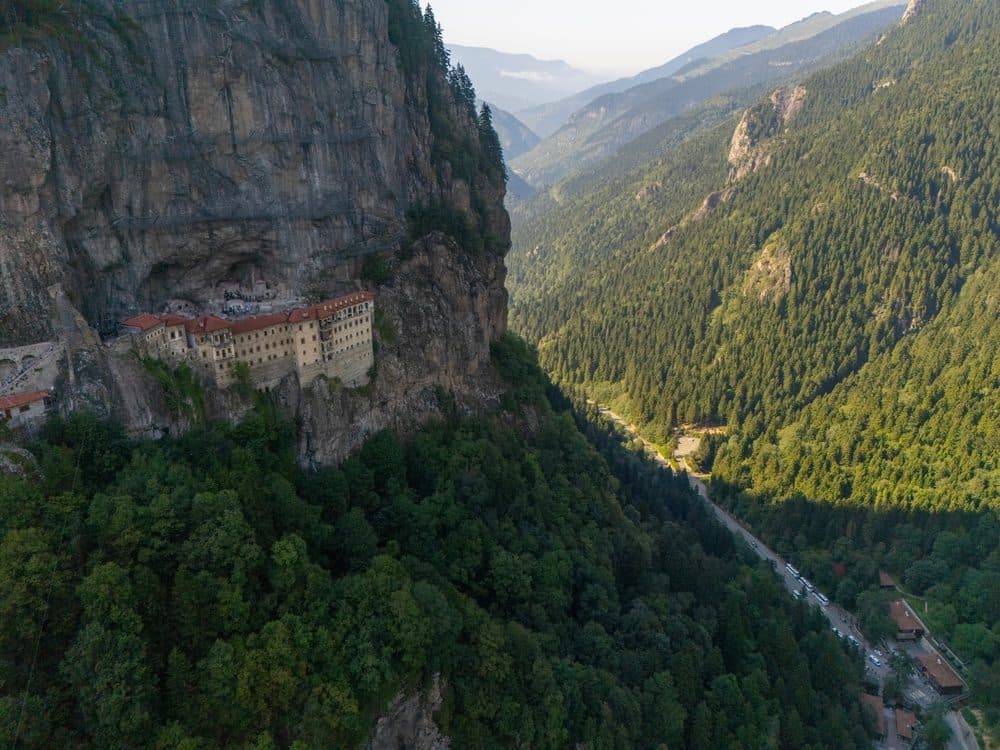
Sümela Monastery
Complete Visitor Guide to Sümela Monastery — Trabzon's Cliff-Side Byzantine Wonder
386
AD Founded
300m
Cliff Face Height
700K
Visitors a Year
01 — Why Visit
A wonder carved into the cliff face.
Sümela Monastery is a Byzantine Greek Orthodox monastery cut directly into a sheer 300-metre cliff in the Altındere Valley. For centuries, pilgrims, monks, and travelers climbed this same steep slope to reach frescoed chapels and rock-hewn cells clinging to the rock. Today it stands as one of the most striking spiritual and architectural landmarks on the Black Sea coast.
02 — Timeline
Stone by stone, a faith carved into rock.
Legend holds that two monks from Athens founded the monastery here in honor of an icon of the Virgin Mary.
Under the Komnenos dynasty the monastery grows, and the rock church's frescoes are painted in layers.
The population exchange empties the monastery, leaving it silent for decades.
Restored, Sümela lives on as a visitable museum-monastery inside Altındere National Park.
04 — Experiences
Ways to explore the monastery.
The rock church, layered frescoes, and valley panoramas — all in one visit.
The Rock Church
Walk through the main chapel carved directly into the cliff face.
Learn more →Frescoes
Byzantine-era wall paintings layered across centuries of devotion.
Learn more →Inside the Monastery
Monks' cells, the library, and the courtyard within the complex.
Learn more →Architecture
One of the Black Sea's most striking examples of rock-cut construction.
Learn more →Photography Guide
Best light, angles, and timing for the classic cliffside shot.
Learn more →Altındere National Park
The forest, waterfalls, and hiking trails surrounding the monastery.
Learn more →05 — Visit Guide
A day on the cliffside.
Three practical tips for timing your visit and routing it right.
Best hours
Arrive early morning — the tour buses haven't arrived yet, and valley mist still clings to the cliffs.
Book ahead
Summer entry slots fill up fast; an e-ticket gets you straight past the queue.
Plan from Trabzon
About an hour from central Trabzon — an easy day trip by tour bus or private transfer.
Sümela Monastery: A Cliffside Byzantine Treasure
Sümela Monastery (Sümela Manastırı; Greek: Panagia Soumela) is a Greek Orthodox monastery dedicated to the Virgin Mary (Panagia), built directly into a sheer rock face of Karadağ ("Black Mountain") in the Altındere valley, in the Maçka district roughly 50 km south of Trabzon on Turkey's Black Sea coast. Perched at an altitude of about 1,150–1,200 meters and clinging some 300 meters above the valley floor, it sits inside Altındere National Park, surrounded by dense pine and spruce forest. Coordinates: 40.6861, 39.6572.
Founded in 386 AD during the reign of Byzantine Emperor Theodosius I, the monastery was established, according to tradition, by two Athenian monks named Barnabas and Sophronius who followed a miraculous icon of the Virgin Mary — said to have been painted by the Apostle Luke — to a cave on this cliff. You can read the full story on our legend page and the complete timeline on our history page.
Today Sümela is one of the most photographed and visited heritage sites in Turkey, drawing travelers who come for its dramatic architecture, its Byzantine frescoes, and the sheer improbability of a multi-storey monastery built onto a vertical cliff.
Quick Facts
| Detail | Information |
|---|---|
| Founded | 386 AD, reign of Emperor Theodosius I |
| Dedicated to | The Virgin Mary (Panagia) |
| Location | Altındere valley, Maçka, ~50 km south of Trabzon |
| Altitude | ~1,150–1,200 m (about 300 m above the valley floor) |
| Coordinates | 40.6861, 39.6572 |
| Ticket (foreign visitors) | €20 (~$22) — verify current on muze.gov.tr |
| Müzekart | Valid for Turkish citizens |
| Hours (summer, Apr–Oct) | ~08:00–18:30, last entry ~1 hour before closing |
| Hours (winter, Nov–Mar) | ~08:00–16:30, last entry ~1 hour before closing |
| Closed | Open daily; fog/snow can limit winter access |
| Nearest city | Trabzon (~1–1.5 h drive) |
What Makes Sümela Special
Sümela's Rock Church, the monastery's main cave church, is covered — inside and out — with layers of Byzantine frescoes depicting the Creation, the life of Christ, and scenes from the life of the Virgin Mary. Beyond the Rock Church, the complex includes several small chapels, monk cells, a library, a kitchen, guest quarters, a sacred spring (ayazma), and a large arched aqueduct that once supplied water to the site. Explore the full layout on our inside the monastery guide.
The monastery flourished under the Empire of Trebizond (the Komnenos dynasty, 1204–1461), especially under Emperor Alexios III, and continued operating for centuries under Ottoman protection after the 1461 conquest of Trebizond, when sultans issued firmans (imperial decrees) guaranteeing its safety. It was finally abandoned in 1923 during the Greek–Turkish population exchange, when the sacred icon and relics were carried to Greece, where they remain today at the new Panagia Soumela monastery near Veria.
A major restoration campaign ran from roughly 2015 to 2019, and the site reopened progressively between 2019 and 2020. Some sections may still be under conservation, so scaffolding or partial closures are possible on any given visit — see our how was it built page for details on the engineering behind the site and its restoration.
Planning Your Visit
Most travelers visit Sümela as a half-day or full-day trip from Trabzon. The drive takes about 1 to 1.5 hours via Maçka to the entrance of Altındere National Park, after which visitors either ride a shuttle partway up or hike a steep forest trail (about 30–45 minutes) to reach the monastery gate. Check our tickets and opening hours pages before you go, and budget at least half a day once you include the national park entrance, the walk, and time inside.
Nearby Attractions
Trabzon city itself is worth combining with a Sümela visit — highlights include the Hagia Sophia of Trabzon (Trabzon Ayasofyası), the Atatürk Köşkü mansion, and Trabzon Castle. Further afield, the alpine lake village of Uzungöl and the Zigana pass are popular add-ons, while history enthusiasts sometimes also visit Vazelon Monastery, a more ruined cliffside monastery near Maçka. See our full guide to the region on the nearby attractions page.
Frescoes and the Rock Church
The single most photographed feature at Sümela is the Rock Church, whose cave walls — both inside and along the exposed cliff face — are covered in layers of Byzantine frescoes. These paintings depict biblical scenes including the Creation, the life of Christ, and episodes from the life of the Virgin Mary, painted by generations of monks primarily during the monastery's golden age under the Empire of Trebizond. Centuries of graffiti and exposure have damaged parts of the paintings, but the surviving fresco cycles remain among the most significant Byzantine religious art in Turkey. Read more on our dedicated frescoes and rock church pages.
The Legend Behind the Founding
Sümela's origin story is inseparable from its physical setting. Tradition holds that an icon of the Virgin Mary, said to have been painted by the Apostle Luke, was carried by angels to the cave on this cliff, where the monks Barnabas and Sophronius found it after being guided there by a vision. This legend explains both the monastery's dedication to the Virgin Mary and its remote, hard-to-reach location — details that still resonate with the Orthodox pilgrims and heritage travelers who visit today. The full story is told on our legend page.
Frequently Asked Questions
Sümela Monastery continues to be one of the most searched historical sites in Turkey, and for good reason: it combines a rare architectural setting with over 1,600 years of continuous history. Whether you're planning a day trip from Trabzon or building it into a longer Black Sea itinerary, understanding its layout, ticket system, and seasonal hours in advance will make your visit far smoother. Start with our tickets and opening hours guides, then explore the history and legend behind one of Turkey's most extraordinary heritage sites.